Understanding Thermal Printer Language: A Quick Guide
Thermal printer language is a set of commands that tell your printer exactly what to print and how to print it. These languages are often referred to as printer command languages or PCLs. They allow your computer to communicate with your thermal printer, ensuring your labels and receipts come out just right. We found that understanding this language is key to troubleshooting and getting the best results.
Think of thermal printer language as the printer’s own special alphabet and grammar. Different printers use different languages, like ZPL (Zebra Programming Language) or EPL (Eltron Programming Language). Knowing which language your printer uses can save you a lot of headaches. We’ve seen many users struggle simply because they didn’t realize their printer was speaking a different language.
- Thermal printer language is how computers talk to printers.
- It’s a set of commands for printing text and graphics.
- Common languages include ZPL and EPL.
- Understanding the language helps fix printing problems.
- It ensures labels and receipts print correctly.
Ready to decode those cryptic printer codes? Let’s dive in and demystify thermal printer languages so you can get your printer working like a charm.
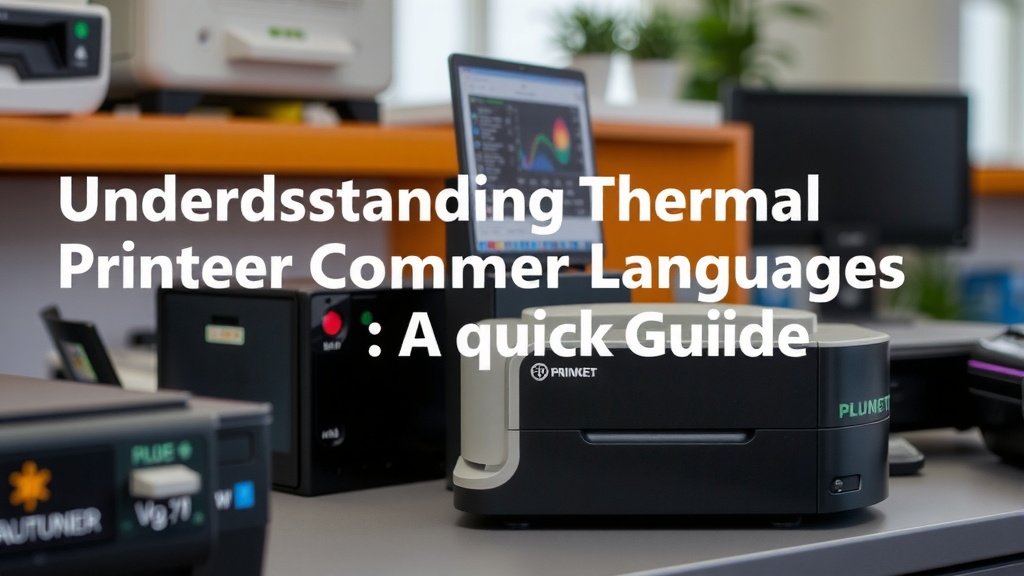
Understanding Thermal Printer Command Languages
These languages are the secret instructions that tell your thermal printer exactly what to do. They guide the printer on what text to display, where to place it, and how to format graphics. You can think of them as the printer’s native tongue. Different brands and models use different command languages. Learning these languages helps you control your printer more precisely.
Why Printer Languages Matter
When you send a document to your printer, it doesn’t just magically appear. Your computer sends a stream of commands. These commands are written in a specific printer language. The printer then reads these commands and executes them. If the language doesn’t match, you’ll get gibberish or nothing at all.
Understanding the language your printer uses is key. It helps you troubleshoot printing errors. It also lets you customize your printouts beyond basic settings. You might want to change font sizes or add logos. This is where knowing the command language becomes really useful. Many users find that a simple language mismatch causes their printing woes.
Common Thermal Printer Command Languages
There are several popular thermal printer languages. Each has its own set of commands and syntax. Knowing which one your printer supports is the first step. We’ve found that most users stick with the language their printer came with.
Zebra Programming Language (ZPL)
ZPL is a widely used language, especially for Zebra printers. It’s known for its power and flexibility. ZPL allows for complex label designs. You can create intricate barcodes, text fields, and graphics. Many businesses rely on ZPL for their labeling needs. It’s a robust language for professional printing. We’ve seen many guides focus on ZPL because of its prevalence.
Eltron Programming Language (EPL)
EPL is another common language, often found in Eltron (now Zebra) printers. It’s generally considered simpler than ZPL. EPL is great for basic label formats. It’s often used for simpler receipts or inventory labels. If you have an older Eltron printer, you likely use EPL. It’s easy to learn for straightforward tasks.
Other Printer Languages
Beyond ZPL and EPL, other languages exist. Some manufacturers use their own proprietary languages. Others might support generic languages like ESC/P or PCL. However, ZPL and EPL are the most common in the thermal printing world. Always check your printer’s manual for specifics. It’s best to stick with what your printer is designed for.
How Thermal Printer Languages Work
Think of these languages as recipes for printing. Each command is an ingredient or an instruction. The printer follows the recipe step-by-step. This ensures your output is consistent and accurate. Your printer needs clear instructions to produce readable labels.
The Anatomy of a Printer Command
A typical command in a thermal printer language includes several parts. It usually starts with a special character. This signals the printer that a command is coming. Then, there’s a command code. This code tells the printer what action to perform. Finally, there are parameters. These provide details for the command, like size or position.
For example, a command to print text might look like this: ~T1,200,200,100,0,0,AHello World. This is a simplified example. The ~T might indicate a text command. The numbers could specify position, font, and size. The AHello World is the actual text. This structured format ensures the printer understands precisely what you want. We found that breaking down commands like this makes them less intimidating.
Sending Commands to Your Printer
You typically don’t write these commands by hand. Most of the time, your printer driver or label design software handles this. You use a user-friendly interface. The software then translates your actions into the printer’s language. This is a helpful abstraction layer. It means you don’t need to be a coding expert.
However, sometimes direct command entry is needed. This is common for advanced customization or troubleshooting. You might use a terminal program to send commands. Or, some software allows you to embed raw commands. This gives you maximum control. Learning to send commands directly can solve stubborn issues. Many technical forums discuss sending raw commands for specific problems.
Decoding Common Commands and Concepts
Let’s look at some common elements you’ll find in thermal printer languages. These are the building blocks for creating your print jobs. Understanding these concepts will demystify many commands.
Characters and Fonts
Printers need to know which characters to print. They also need to know how to print them. Commands specify the font type, size, and style. You can often choose from various fonts. Some printers support downloadable fonts. This lets you use custom typefaces. Font commands are fundamental to any print job. They dictate how your text looks.
Positioning and Alignment
Where do you want your text or graphics to appear on the label? Commands control the X and Y coordinates. This allows precise placement. You can align text to the left, right, or center. Proper alignment makes labels look professional. Without these commands, everything would be a jumbled mess. Many users struggle with alignment until they understand these codes.
Barcodes
Thermal printers are excellent for printing barcodes. Command languages include specific codes for barcode generation. You’ll specify the barcode type (e.g., Code 128, QR Code). You also define the data to be encoded. The printer handles the rest. Barcode commands are highly specialized. They ensure scannability and accuracy. Accurate barcode printing is essential for inventory and retail. We found that incorrect barcode commands lead to scanning errors.
Graphics and Images
You can often print simple graphics or logos. This involves converting the image into a format the printer understands. Command languages have instructions for this. You might need to specify the image size and placement. Some languages support bitmap images. Others might have more advanced graphics capabilities. Printing graphics adds branding to your labels. It enhances their professional appearance. Always check your printer’s specifications for image support.
Control Commands
These commands control the printer’s behavior. They can include things like:
- Cutting the label after printing.
- Feeding a certain amount of material.
- Setting the print speed.
- Clearing the printer’s memory.
Comparing ZPL and EPL: A Quick Look
To give you a clearer picture, let’s compare the two most popular languages. This might help you identify which one you’re working with.
| Feature | ZPL (Zebra Programming Language) | EPL (Eltron Programming Language) |
|---|---|---|
| Complexity | More powerful, but also more complex. | Simpler and easier to learn for basic tasks. |
| Graphics Handling | Handles complex graphics and scalability well. | Supports basic graphics; can be more limited. |
| Barcode Support | Extensive support for various barcode types. | Good support for standard barcodes. |
| Command Structure | Uses field delimiters like ‘^’ and ‘~’. | Uses commands starting with characters like ‘N’, ‘L’, ‘B’. |
| Use Cases | Complex labels, variable data, high-volume printing. | Simpler labels, receipts, inventory tags. |
As you can see, ZPL offers more advanced features. EPL is a good choice for simpler needs. Most software can generate code for either. However, if you’re troubleshooting, knowing the target language is critical. It’s like trying to give directions in two different languages at once.
Tips for Working with Printer Languages
To make your life easier when dealing with thermal printer languages, keep these tips in mind. They are based on common challenges users face.
- Know Your Printer’s Language: This is the most important step. Check your printer’s documentation. Look for a sticker on the printer itself.
- Use Label Design Software: These tools abstract away the complex commands. They translate your visual designs into the correct language.
- Test Small Changes: If you’re modifying commands, do it incrementally. Change one thing at a time and test. This helps isolate issues.
- Consult Your Manual: The printer’s manual is your best friend. It lists all available commands and their parameters.
- Online Resources are Your Friend: Many forums and communities discuss specific printer languages. Search for your printer model and the language it uses.
Don’t get discouraged if it seems complicated at first. It’s a learning process. Even experienced users refer back to documentation. The goal is to communicate effectively with your printer. With a little practice, you’ll become much more comfortable.
Conclusion
Understanding thermal printer language is key to getting your labels and receipts just right. You’ve learned that these languages are the instructions your printer follows, with common ones like ZPL and EPL controlling everything from text placement to barcode generation. While software often handles the translation, knowing the basics helps immensely with troubleshooting. Don’t let those codes intimidate you; even simple label software generates them. The best next step is to check your printer’s manual to confirm its specific language. This knowledge will help you communicate clearly with your printer.
Frequently Asked Questions
What happens if I send the wrong printer language?
If you send commands in a language your printer doesn’t understand, you’ll likely get gibberish text or no output at all. Your printer won’t be able to interpret the instructions. This is a common reason for printing errors and a mismatch is often the culprit.
Can I switch my thermal printer’s language?
Generally, no. A printer is designed and manufactured to use a specific command language. You cannot typically switch it to another language like ZPL if it was built for EPL, for example. You’ll need to ensure your software or driver is set to the language your printer natively supports.
How do I find out which language my printer uses?
The easiest way is to check your printer’s user manual or look for a sticker on the printer itself. Sometimes, the printer driver settings in your computer’s control panel will also indicate the supported language. Online searches for your specific printer model can also provide this information.
Is ZPL or EPL better for beginners?
EPL is generally considered simpler and easier for beginners to learn for basic label needs. ZPL is more powerful and versatile, offering more advanced design options but with a steeper learning curve. For straightforward tasks, EPL is often more approachable.
Do I need to learn the actual code to use a thermal printer?
Most of the time, you don’t need to learn the raw code. Label design software and printer drivers translate your visual input into the correct printer language commands. However, understanding the concepts can help you troubleshoot when things go wrong or for advanced customization.